

Costs and pricing
Loyalty software service costs in three UK cities
Loyalty software service costs in London, Manchester and Edinburgh: compare consultant day rates, implementation fees and monthly support retainers.
What to take away
- London day rates run £900 to £1,400. Manchester sits at £650 to £1,000 and Edinburgh at £700 to £1,100.
- Implementation for a mid-market scheme costs £12,000 to £35,000 in London, £8,000 to £22,000 in Manchester and £9,000 to £25,000 in Edinburgh.
- Monthly retainers run £1,500 to £4,000 in London, £900 to £2,400 in Manchester and £1,000 to £2,800 in Edinburgh.
- Price one scope in all three cities, then fix the rate card for two years with increases capped at published inflation.
The three service-cost bands compared
For loyalty software projects, the figures below cover consultant day rates, implementation and monthly support—not platform licence fees. Use the table before reading any quote.
Consultant day rate
- London
- £900 to £1,400
- Manchester
- £650 to £1,000
- Edinburgh
- £700 to £1,100
Implementation fee
- London
- £12,000 to £35,000
- Manchester
- £8,000 to £22,000
- Edinburgh
- £9,000 to £25,000
Monthly support retainer
- London
- £1,500 to £4,000
- Manchester
- £900 to £2,400
- Edinburgh
- £1,000 to £2,800
UK Loyalty Vendor Rates by City
London
- Day rate
- £900-£1,400
- Implementation fee
- £12k-£35k
- Monthly retainer
- £1,500-£4,000
Manchester
- Day rate
- £650-£1,000
- Implementation fee
- £8k-£22k
- Monthly retainer
- £900-£2,400
Edinburgh
- Day rate
- £700-£1,100
- Implementation fee
- £9k-£25k
- Monthly retainer
- £1,000-£2,800
Implementation fees are fixed prices built from estimated days, not day rates. Scope moves the range more than city.
Retainers often exclude out-of-hours support, new integrations and campaign builds. These are among the hidden costs that catch out finance teams.
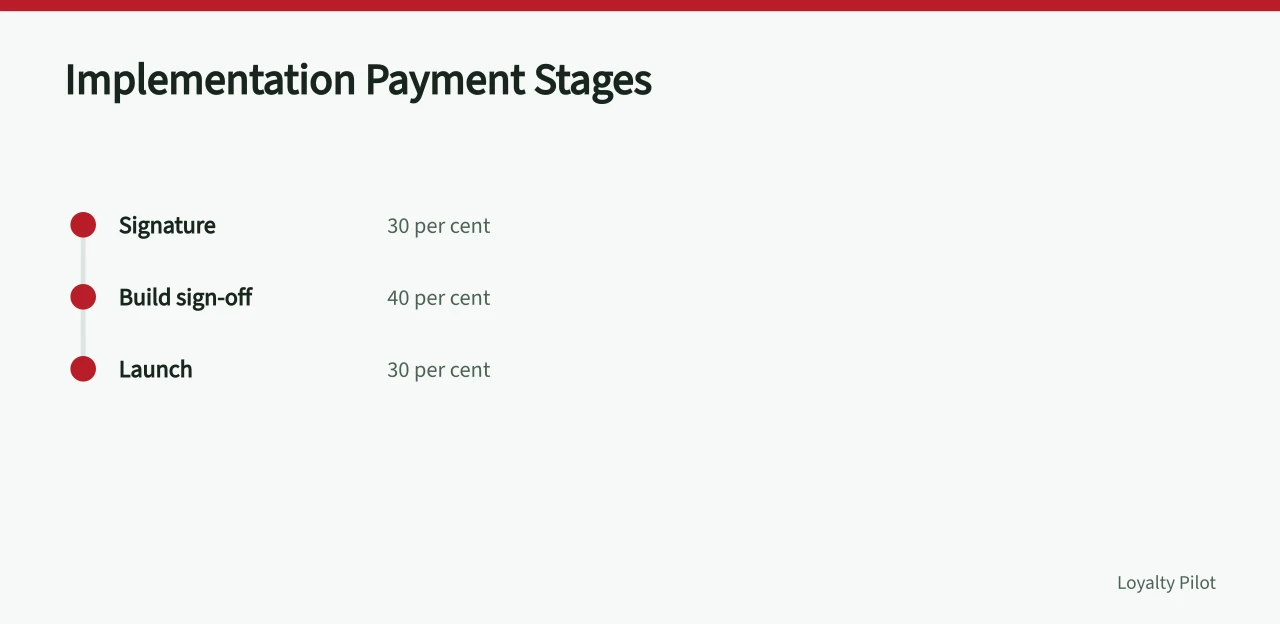
Implementation is normally staged: 30 per cent on signature, 40 per cent at build sign-off, 30 per cent at launch. Staging protects the buyer if the project slips.
What drives the London premium
London holds most UK loyalty vendors, retail groups and the regulators that shape scheme rules, including the CMA and the ICO's guide to UK GDPR. Buyers compete for the same consultants.
Vendors price consultant time against local pay. The ONS employee earnings data shows how far London salaries sit above North West England and Scotland.
Manchester has lower office rents and salaries. Edinburgh sits between, with pay below London and a thinner vendor pool.
Competition sets the discount, so a Scottish buyer can pay more than a Manchester buyer for identical scope.
Per-member and revenue-share pricing across regions
Day rates are one model. Vendors also quote per active member, per transaction or as a share of incremental revenue.
Those models narrow the regional gap. A platform licence or per-member fee is usually set nationally, so it barely changes between the three cities.
What stays regional is the human work: configuration, data migration, campaign builds and account management. Our explainer on what loyalty pricing models mean for your scheme budget shows how each shape moves the year-one total.
Revenue-share deals shift risk to the vendor. Expect a higher share where sales are hard to forecast.
Example: one scope, two rate cards
A North West England retailer with 40,000 members wants a points scheme, one ecommerce integration and a monthly retainer.
The London vendor quotes 20 implementation days at £1,200, so £24,000, plus £2,500 a month support. Twelve months of support is £30,000, making year one £54,000.
The Manchester vendor quotes 20 days at £850, so £17,000, plus £1,600 a month. Twelve months is £19,200, making year one £36,200.
The gap is £17,800 for identical scope. Both totals include the full first year of support.
Building a regional budget
- List every linelicence, implementation, retainer, travel, compliance, contingency.
- Set a rate for each line from the city table.
- Multiply estimated implementation days by the local day rate.
- Add twelve months of retainer plus an inflation assumption.
- Add 10 to 15 per cent contingency for scope changes.
- Compare the three city totals before you sign.
Set the inflation assumption from the ONS inflation and price indices. Our budget template without guesswork shows how to lay the lines out for a finance team.
Negotiating retainers outside London
Manchester's larger vendor pool makes discounts easier to obtain. In Edinburgh, ask for multi-year rate protection early, before the scope is fixed.
Bundle implementation with the first year of support in one price. Vendors often discount implementation to win the retainer, and the discount is larger outside Greater London.
Define included support: change requests, response times, out-of-hours cover and the notice period on exit. Unbounded support is where retainers drift.
Common questions
Do licence fees vary between the three cities?
Rarely. Licences are set nationally or globally, so the regional gap comes from services.
Why can Edinburgh cost more than Manchester for the same scope?
Scotland has fewer loyalty vendors, and Edinburgh's financial services employers compete for the same digital skills.
Should I choose a monthly or an annual retainer?
Monthly retainers cost more per month but exit faster. Annual retainers carry a small discount and lock the budget for a year.
How do I compare a per-member quote with a day rate?
Convert both to a year-one total. Per-member fees scale with membership, day rates with project days.