

Rules and ethics
FCA rules for referral marketing software and rewards
Referral marketing software can support compliant loyalty and referral campaigns, but FCA rules depend on the promotion, approval, disclosures and records.
What to take away
- Referral marketing software helps you spot when a cashback or points offer becomes a financial promotion under FCA financial promotion rules, so you can classify it before launch.
- A reward is usually a financial promotion when it is offered as an inducement to invest, save, borrow or enter a credit agreement, not when it simply discounts a purchase.
- Referral reward disclosure duties apply to the inviter and the scheme owner, including clear terms, eligibility and any exclusions.
- If you are not authorised, an authorised firm's approval may be needed before you communicate a promotion for a regulated product, unless an exemption applies.
- FCA record keeping means you can show what was promoted, to whom, when, and who approved it.
- Keep consumer law, advertising codes and data protection in view alongside FCA rules, because reward claims can breach more than one regime.
When points and cashback become financial promotions
The starting point is what the reward is encouraging. A supermarket points scheme that gives money off groceries is a retail promotion. A cashback offer that pays you for opening an investment account, topping up a pension or taking out a credit card is a financial promotion.
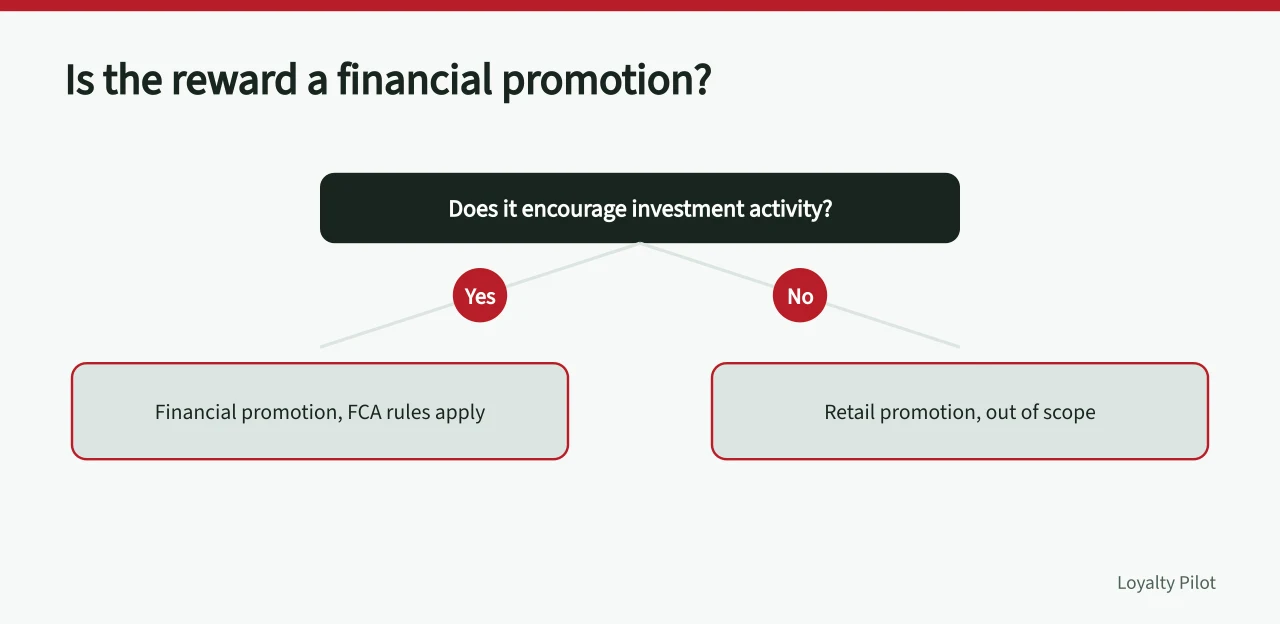
Section 21 of the Financial Services and Markets Act 2000 (FSMA 2000) is the financial-promotion restriction. In the course of business, a person must not communicate an invitation or inducement to engage in investment activity unless the person is authorised, the communication is approved by an authorised person, or an exemption applies. For authorised firms, the FCA's Conduct of Business sourcebook (COBS) 4 includes COBS 4.2.1R and 4.2.2R on communications, COBS 4.3 and 4.5 requirements where applicable, and COBS 4.11 on record keeping.
Cashback and points classification turns on that test, not on the label you use.
A points balance that can be redeemed only against goods or services is generally not a financial promotion. The same balance becomes one if it can be converted into cash, invested, or used to reduce a regulated credit balance. Conversion features are the usual trigger.
Cashback paid into a savings account or used to buy investments is also caught. So is a bonus paid for switching a current account, because the inducement relates to a regulated product. A discount on a non-financial product is not.
Classification is not static. If you add a partner that offers investment products, the same points mechanic can move into scope. Review the reward catalogue each time it changes, and record the reasoning. For a wider look at consent, disclosure and ad claims, see consent, disclosure and ad claims.
Apply the statutory test: is a person communicating, in the course of business, an invitation or inducement to engage in investment activity? The fact that a reward is cash or a financial product does not, by itself, settle the question. If the communication may meet the test, identify the relevant activity and product, then check whether the communicator is authorised or a specific exemption applies.
Consumer law runs alongside. The Consumer Protection from Unfair Trading Regulations 2008 prohibit misleading actions and omissions about the nature of a promotion, including hidden conditions. That applies whether or not the FCA regime is engaged. The CMA's Unfair commercial practices: a guide for businesses (CMA207) explains how to assess claims and omissions in promotions.
Referral rewards that trigger FCA disclosure duties
Referral schemes often sit on the boundary. A customer who recommends a friend to a retailer is not making a financial promotion. A customer who recommends a friend to an investment platform may be, depending on what they say and whether they are paid.
Referral scheme: regulated or not?
Retail referral
- Product
- Goods or services
- Reward
- Discount or points
- Disclosure
- CAP Code only
- Referrer status
- No approval needed
Regulated referral
- Product
- Investment or credit
- Reward
- Commission or cash
- Disclosure
- FCA duties apply
- Referrer status
- Appointed rep or exempt
A referral is not automatically a financial promotion. Under FSMA 2000 section 21, the question is whether the communication is an invitation or inducement to engage in investment activity and is made in the course of business. A paid referrer may cross that line if their message encourages a friend to take up a regulated product; the message and the surrounding arrangement matter. Depending on the activity, the person making it may need to be an appointed representative or fall within a specific exemption.
The communication must meet the applicable FCA standard: COBS 4.2.1R requires communications and financial promotions to be fair, clear and not misleading, and COBS 4.2.2R adds related communication requirements. Make the reward, its value, eligibility and conditions clear where they are material to the decision. Identify who is making the communication and on whose behalf, and make any paid relationship clear.
The Financial Services and Markets Act 2000 (Financial Promotion) Order 2005 (FPO) contains specific exemptions, not a general exemption for referral schemes. For example, FPO article 19 covers communications to investment professionals and article 49 covers specified high-net-worth entities; each has recipient and communication conditions. The introductions exemption in article 33 is also limited to qualifying circumstances. Check the exact conditions against the recipient, product and communication before relying on an exemption.
Advertising codes add a layer. The CAP Code requires promotions to be clear, fair and not misleading. Rule 2.1 requires marketing communications to be obviously identifiable as such; rules 3.1 and 3.3 address misleading claims and omissions; rule 8.17 requires significant conditions for promotions to be communicated. Referral advertising must not disguise an advert as editorial or personal advice.
A useful example is a cashback site that pays members for signing up to a credit card. The site is communicating a financial promotion. It needs either authorisation, an exemption, or approval from an authorised firm. The member who refers a friend may also be caught if they are paid and the friend is encouraged to apply.
In practice, most retail referral schemes avoid the regime by keeping the reward tied to a non-regulated purchase. The moment you add a credit card, loan, savings or investment partner, treat the whole mechanic as a financial promotion and build the disclosures in from the start.
What scheme owners must disclose and to whom
Disclosure has two audiences: the person being referred and the person doing the referring. Both need enough information to understand the deal and the risks.
Disclosure checklist for both audiences
- Referred customerfirm identity and product nature
- Referred customerreward, conditions and exclusions
- Referred customerapproval or exemption status
- Referrerreward is payment for introduction
- Referrerpayment timing and tax conditions
- Bothlawful basis under UK GDPR
For the referred customer, make clear the identity of the firm, the nature of the product, the reward and its conditions, and any material exclusions. These details help the promotion meet the applicable fair, clear and not misleading standard. If the promotion is approved by an authorised firm, say so. If it is exempt, record the specific FPO provision and why its conditions are met.
For the referrer, disclose that the reward is a payment for an introduction, how and when it is paid, and any tax or eligibility conditions. Do not bury this in a long terms page. Put it where the referral is made.
The CMA's Unfair commercial practices: a guide for businesses (CMA207) is a useful reference because it covers misleading actions and omissions. Use it to check whether reward claims and significant conditions are presented fairly.
Data protection sits alongside. For referral tracking, identify a lawful basis under UK GDPR Article 6, provide privacy information under Article 13 and follow the principles in Article 5, including purpose limitation and data minimisation. PECR regulation 6 applies when storing information on, or accessing information from, a person's device, subject to its exceptions. PECR regulation 22 generally requires consent for unsolicited email or text marketing to individual subscribers, unless the limited existing-customer soft opt-in applies; a referrer supplying a friend's details does not itself establish consent. Follow the ICO's Direct marketing guidance. Before you launch, it is sensible to check UK marketing regulations across the ICO, CMA and FCA regimes.
Timing matters. Disclosures must be made before the customer acts, not after. A reward that appears only in a confirmation email is too late if the customer has already applied for the product.
Language matters too. Avoid implying that a referral is impartial advice. If the referrer is paid, say so plainly and make the advert identifiable under CAP Code rule 2.1. The ASA administers the CAP Code, including its rules on misleading claims and significant promotional conditions.
A simple disclosure block at the point of referral should cover: who is promoting, what the reward is, what the customer must do, when the reward is paid, and where to complain. Keep it short enough to scan on a phone.
Financial promotion rules for referral marketing software
Referral marketing software does not remove your regulatory duties. It can help you meet them, but only if it is configured for UK rules rather than US ones.
Configuring referral software for UK rules
- Tag each rewardretail, cashback, points, regulated
- Set approval gates before regulated campaigns go live
- Store audit logs of creative, targeting and approvals
- Archive referral links and landing pages
- Export campaign history for compliance reviews
Start with classification fields. Your platform should let you tag each reward as retail, cashback, points or regulated. That tag should drive the disclosure text and the approval workflow. Without it, every campaign needs manual review.
Build approval gates into the workflow. A campaign that includes a regulated partner should not go live until an authorised approver has signed it off. The software should record who approved it, when, and which version.
Keep audit logs. FCA record keeping requires you to reconstruct what was communicated. Your platform should store the creative, the targeting, the disclosure text and the approval trail for the retention period your compliance team sets.
Watch the referral link itself. If a member shares a link that leads to a regulated application, the link is part of the promotion. Your software should be able to show the landing page and the disclosure that appeared with it.
Reporting should be exportable. Compliance teams need to pull a campaign history quickly during a review. If your platform cannot export a clean record, you will be doing it by hand.
Finally, keep the platform's own claims honest. If your marketing says a scheme is FCA approved, that is itself a financial promotion. For a broader view of how to keep loyalty marketing advertising rules compliant, review the claims you make about the scheme.
Working with authorised partners and approvers
If you are not authorised, FSMA 2000 section 21(2)(b) provides the route for an authorised person to approve a financial promotion. The approving firm must have the relevant FCA permission under section 55NA; authorisation alone is not enough. Check the firm and its permissions on the FCA Financial Services Register, and confirm that its permission covers approving financial promotions.
Working with authorised approvers
- Share creative, targeting, reward terms and data flows
- Put the approval arrangement in writing
- Get re-approval for any changes after sign-off
- Monitor what is actually published
- Appoint representatives formally and notify the FCA
Approval is not a rubber stamp. Under the FCA's COBS 4.10 rules, an authorised firm approving promotions for unauthorised persons must meet the applicable competence, expertise, due-diligence and ongoing-monitoring requirements. The approver needs the information to assess the promotion, including the creative, targeting, reward terms and data flows, before sign-off.
Put the arrangement in writing. A short agreement should cover who approves what, turnaround times, who handles complaints, and what happens if the promotion changes. Changes after approval need re-approval.
If you are an authorised firm using referrers, you remain responsible. You cannot outsource your regulatory duties to a marketing agency or a software vendor. Monitor what is actually published, not just what was approved.
Appointed representatives are a separate route. An appointed representative may communicate promotions within the scope of its appointment and the principal's responsibility. The appointment must be formal and notified to the FCA. Check the relevant status and details on the FCA Financial Services Register.
Exemptions exist but are narrow. The Financial Services and Markets Act 2000 (Financial Promotion) Order 2005 includes, for example, the investment-professional exemption in article 19, the specified high-net-worth entity exemption in article 49 and an introductions exemption in article 33. Each is limited by conditions such as who receives the communication and what it says. Do not assume a retail referral scheme is exempt just because the reward is small.
A practical rule: if you cannot explain in one sentence why the promotion is exempt or approved, it is neither. Get advice before launch, not after a complaint.
Record-keeping under COBS 4.11
Record keeping is where most schemes fail. COBS 4.11 sets FCA record-keeping requirements for financial promotions. Firms need to be able to show what was communicated, to whom, when, and who approved it. If you cannot produce that, you cannot demonstrate compliance.
Keep records for the period your compliance team sets, which is usually at least five years for financial promotions. Store them where they can be retrieved quickly, not in a marketing folder that nobody owns.
Keep the final creative and each version, the disclosure text, the targeting criteria, the approval chain, and any complaints or withdrawals. Record the classification and, if relying on an exemption, the FPO provision and the reasons its conditions apply. If a campaign was amended, keep every version.
Use this checklist as a minimum standard for each campaign:
- The final creative, channel, landing page and each version used.
- The audience and targeting criteria, including who received the communication and when.
- The classification decision and its reasoning, including the product or activity promoted.
- The disclosures and reward terms shown at the point of referral.
- The approver's identity, relevant permission, approval decision and date, or the specific exemption relied on and evidence that its conditions were met.
- Any complaints, withdrawals or changes, with the resulting action recorded.
Minimum record-keeping standard
- Reward classification recorded
- Disclosure text approved and stored
- Authorised approver named with date and version
- Targeting and eligibility criteria documented
- Referral link and landing page archived
- Complaint handling route recorded
- Retention period set and applied
A worked example shows how this fits together. A retailer launches a points scheme with a credit card partner. The reward is classified as regulated. The disclosure block names the card issuer and the reward. The card issuer's compliance team approves the creative.
The software logs the approval, the targeting and the landing page. Six months later, the FCA asks about the promotion. The retailer exports the record in an hour.
Without that workflow, the same scheme would rely on email threads and memory. That is not a record. It is a risk.