

Reviews
Part of What impartial loyalty marketing review criteria mean for platform buyers
Loyalty marketing product comparison: LoyaltyLion, Yotpo, Smile.io, Antavo, Eagle Eye and Comarch
A buyer's comparison of LoyaltyLion, Yotpo, Smile.io, Antavo, Eagle Eye and Comarch, with pricing models, fit and limits to check before you shortlist.
What to take away
A loyalty marketing product comparison should name real products and score their fit against written requirements.
- LoyaltyLion and Smile.io suit ecommerce teams that want quick rewards launches.
- Yotpo bundles loyalty with reviews and messaging, which can reduce vendor count.
- Antavo and Comarch target complex enterprise schemes with custom pricing.
- Eagle Eye is a UK option for large retail programmes such as Asda Rewards.
- Salesforce Loyalty Management fits firms already using Salesforce Customer 360.
That definition takes a sentence; the discipline takes weeks. For example, a team paying £400 a month may still face £9,000 of one-off integration work, which changes the ranking entirely. The wider reviews and comparison methods guide sets out how to keep scoring honest.
Compare named products on fit, cost and limits
Cost figures are indicative and labelled typical.
Compare named products
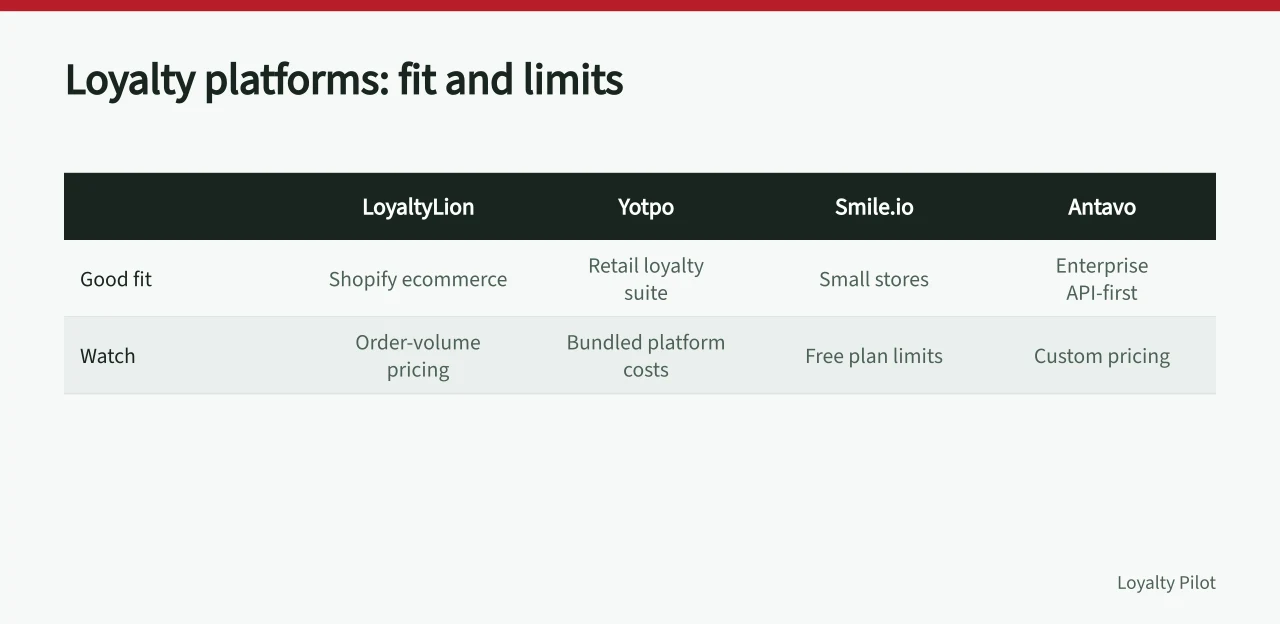
Good fit
- LoyaltyLion
- Shopify-led ecommerce teams needing points, referrals and rewards
- Yotpo
- Retailers wanting loyalty plus reviews, SMS and email in one suite
- Smile.io
- Small ecommerce stores testing a simple rewards programme
- Antavo
- Enterprise brands with API-first and multi-market needs
- Eagle Eye
- Large UK retailers, grocers and hospitality schemes
- Comarch
- Complex loyalty programmes across retail, banking or travel
- Salesforce Loyalty Management
- Companies already on Salesforce Customer 360
- Open Loyalty
- Mid-market teams with developer resource and API needs
- Talon.One
- Dynamic promotions and real-time loyalty rules
- SessionM
- Large brands with data teams and Mastercard ownership
Watch
- LoyaltyLion
- Pricing often rises with monthly order volume
- Yotpo
- Loyalty is part of a wider platform, so costs can bundle
- Smile.io
- Free plan has member or order limits; paid tiers scale
- Antavo
- Custom pricing and longer implementation
- Eagle Eye
- Programme pricing is quoted, not listed publicly
- Comarch
- Cloud or on-premise deployment adds setup work
- Salesforce Loyalty Management
- Contract is an add-on to a wider Salesforce licence
- Open Loyalty
- Tiered plans plus a self-hosted licence that shifts hosting duties to you
- Talon.One
- Custom pricing suits larger budgets
- SessionM
- Enterprise-only sales process
Indicative cost
- LoyaltyLion
- Published tiers, low hundreds a month typical
- Yotpo
- Quoted, bundled with reviews and messaging
- Smile.io
- Free tier, then paid plans from under £50 a month
- Antavo
- Quoted, enterprise band
- Eagle Eye
- Quoted per programme
- Comarch
- Quoted, licence plus implementation
- Salesforce Loyalty Management
- Quoted annually as an add-on
- Open Loyalty
- Tiered plans plus self-hosted fee
- Talon.One
- Quoted, custom pricing
- SessionM
- Quoted, enterprise only
The table is a starting point, not evidence. Ask each named supplier for the same written answers. If you are still assembling candidates, loyalty marketing best providers in England covers how a longlist is usually built.
Pricing drivers and the quote-only vendors
Pricing tracks a few drivers: member count, monthly order volume, message volume and support level. LoyaltyLion publishes entry tiers in the low hundreds of pounds a month for small stores. Smile.io keeps a free tier and charges more as orders grow.
Antavo, Eagle Eye and Comarch quote per programme or per member, typically in the tens of thousands of pounds a year. UK quotes are in pounds, exclude VAT at the standard 20% rate and usually bill annually in advance.
Eagle Eye runs large UK retail, grocery and hospitality schemes on its own platform, and Asda Rewards is a public example. It quotes per programme, so onboarding, integration and messaging appear as separate lines.
Comarch sells loyalty software to retailers, banks and travel brands, with cloud or on-premise deployment. An on-premise install puts hosting, patching and database work on your team, which moves spend from subscription to headcount.
Define must-haves and weightings
A must-have removes a supplier from the shortlist if it fails. Weightings then order the suppliers that pass. Typical must-haves include an exportable member database, a documented API and support hours that match your trading pattern. Weightings should reflect business impact, not how easy a feature is to demo.
Keep to around fifteen scored criteria. More than that and the scores blur. Publish the weightings to suppliers early so their answers address your priorities rather than their standard deck.
Use a five-point scale and define what each point means before scoring starts. A three for one supplier has to mean the same as a three for another, or the totals mislead. Anchors such as no evidence, written commitment or tested in a sandbox keep reviewers aligned.
Set the evidence bar for each score
Every score needs a source: a written answer, a contract clause, a sandbox test or a named reference. A claim made in a sales call is a note, not evidence. Ask for the same artefact from every supplier so the comparison stays fair.
Where a supplier will not confirm something in writing, score it as unproven and say so. That discipline removes most of the optimism that creeps into shortlists.
Compare cost, data and claims on the same basis
Total cost over three years
Ask for a three-year view: subscription, onboarding, integration, message volumes and exit costs. A low headline fee often hides per-message charges that scale with your member base. Model two or three growth scenarios and label them illustrative.
Three-year cost lines to request
- Subscription fees
- Onboarding and setup
- Integration work
- Message volumes
- Exit costs
- Internal staff time
Put every supplier's numbers in one table with the same assumptions, and include your own staff time. Where a supplier will not quote in writing, leave the line blank. Blank lines have a habit of arriving as invoices later.
Data, consent and advertising rules
Loyalty schemes process personal data, so your comparison must cover lawful basis, retention and subject requests. The Data Protection Act 2018 is the legal grounding here, and its full text on legislation.gov.UK is worth reading alongside supplier answers.
Marketing messages need valid consent and a clear opt-out. The ICO's PECR training videos for marketing teams are a sensible check before you approve a communications flow. For claims and promotions, the ASA and CAP research on advertising and consumer behaviour shows how wording is likely to be read.
Score the shortlist, then decide
Match the situation to the right supplier type
Match the situation
Choose
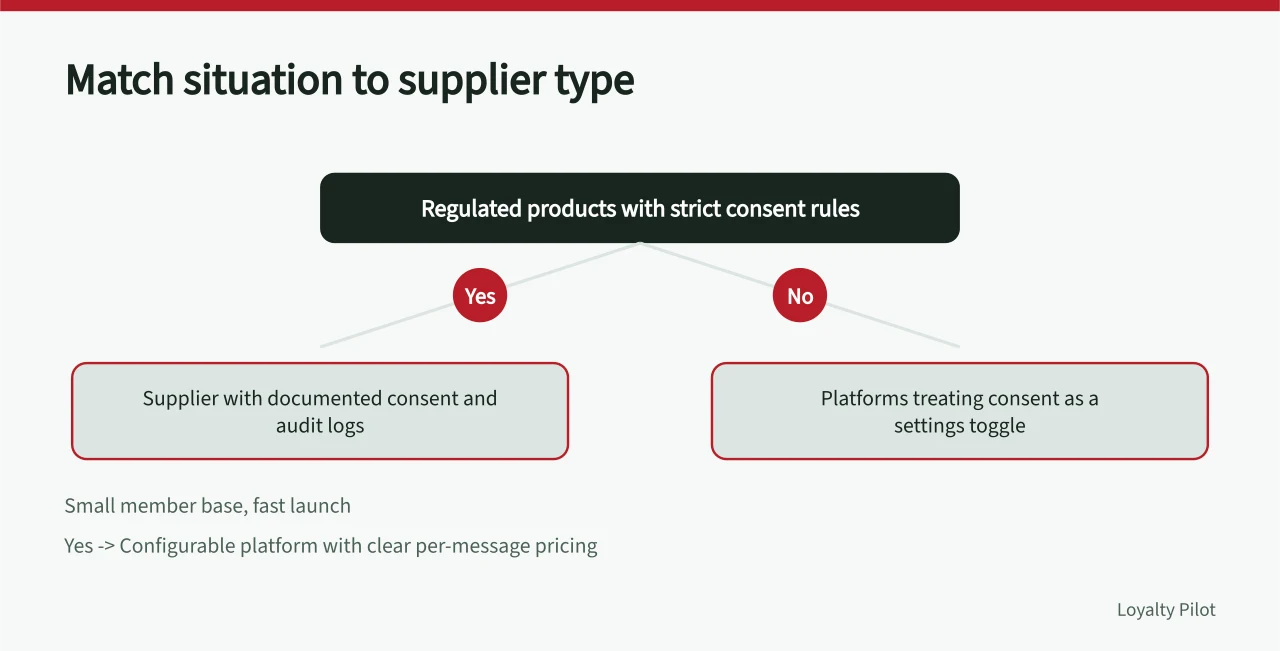
- Regulated products with strict consent rules
- Supplier with documented consent and audit logs
- Small member base, fast launch
- Configurable platform with clear per-message pricing
- Complex CRM and ecommerce integrations
- Supplier with a tested API and named references
- Tight internal resource
- Managed service with defined service levels
- Long-term scheme with frequent changes
- Contract with clear exit and data export terms
Avoid
- Regulated products with strict consent rules
- Platforms that treat consent as a settings toggle
- Small member base, fast launch
- Enterprise suites with heavy onboarding fees
- Complex CRM and ecommerce integrations
- Vendors who discuss integration only after signing
- Tight internal resource
- Tools needing a dedicated developer from day one
- Long-term scheme with frequent changes
- Contracts that lock data behind a migration fee
Head-to-head scores for the six named products
The scores are ours, for a mid-market ecommerce scheme. Weights: fit 25, three-year cost 20, integration 15, data 15, support 15, exit 10.
Head-to-head scores
| Product | Fit | Cost | Integration | Data | Support | Exit | Weighted total |
|---|---|---|---|---|---|---|---|
| Antavo | 5 | 2 | 5 | 4 | 4 | 3 | 78 |
| LoyaltyLion | 4 | 4 | 3 | 3 | 4 | 3 | 72 |
| Yotpo | 4 | 3 | 3 | 4 | 4 | 3 | 71 |
| Eagle Eye | 4 | 2 | 4 | 4 | 4 | 3 | 70 |
| Smile.io | 3 | 5 | 3 | 3 | 3 | 3 | 68 |
| Comarch | 4 | 2 | 4 | 4 | 4 | 2 | 68 |
On these weights Antavo leads, with LoyaltyLion and Yotpo close behind. Eagle Eye follows, then Smile.io and Comarch level on 68. Raise the cost weight to 35 and Smile.io climbs; raise integration and Comarch gains. Publish the weights before scoring.
Score, review, then sign
Two reviewers score independently, then reconcile differences in writing. A gap usually means a different reading of the same requirement. Sign only after finance, legal and the data owner have seen the scorecard.
Keep a short decision note with the scorecard: who reviewed what, which gaps remain, and what would change the answer. That note is what protects the team if the scheme underperforms later.
Common questions
How many suppliers should a comparison include?
Three to five is usually enough to test the market without exhausting the team. Fewer than three gives little contrast on price or approach.
What should a scorecard weight most heavily?
Weight the criteria that cause failure: data handling, integration, support and total cost. Features that merely impress in a demo sit lower.
How long should the comparison take?
For a mid-sized scheme, allow four to six weeks from requirements sign-off to a decision. Rushing creates evidence gaps that reappear during contracting.
Can we reuse the scorecard at renewal?
Yes. Reuse the criteria and weightings, update the evidence, and renewal becomes a short refresh rather than a new procurement project.